
OopBuy Shipping: Keep Destination and Package Scope Together
A useful OopBuy shipping comparison keeps the destination and parcel assumptions together. Record weight, dimensions, contents, currency and the stage represented by each amount. You can compare estimates before packing, but label their assumptions rather than presenting them as measured parcel data.
Inspect the mint-green knit if you are considering another layer. Keep its selected option and quantity separate from delivery inputs: a listing title does not supply packed dimensions, a current shipping rate or an accepted parcel.
Ask what each amount includes
Before comparing totals, separate the merchandise amount from the transport estimate and any separately listed services. Read the description of each line instead of assuming that a prominent number includes everything you may choose later.
| Amount you are comparing | Context to preserve |
|---|---|
| Product amount | Item, selected option, quantity, currency and date |
| Shipping estimate | Destination, parcel inputs, service and conditions |
| Optional service | What was selected and what the stated charge covers |
| Revised total | Which inputs or selections changed from the earlier version |
These categories help read an offer; they are not a list of fees guaranteed to apply to every OopBuy purchase. If a position is unclear, ask about that position before adding an assumed value to your budget.
A historical quote shows why context matters
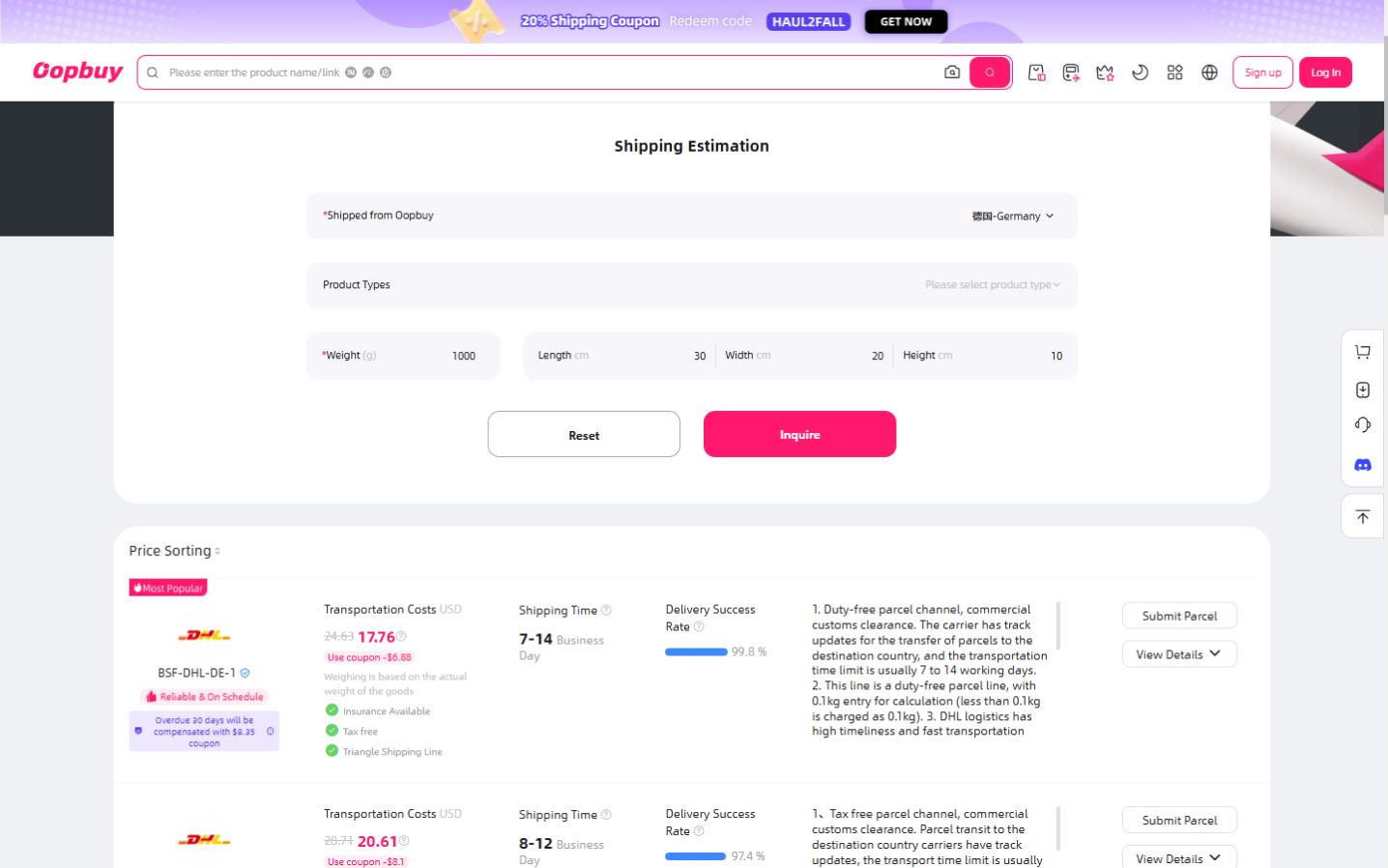
A calculator screenshot archived on 10 September 2026 showed a Germany scenario using 1,000 g and 30 × 20 × 10 cm. The BSF-DHL-DE-1 entry displayed 17.76 USD alongside a coupon annotation, while the product-type field was unselected. This is a historical display, not a current offer or evidence that a particular garment was accepted for that service.
The missing product selection matters when comparing eligibility, and the coupon annotation matters when comparing amounts. Do not read the figure as an unconditional rate, convert it to euros without an exchange-rate basis, or use it as a tariff for a different destination.
Compare services without changing the parcel underneath
To compare two services, keep the proposed contents and package inputs the same. Read the applicable restrictions and included features rather than judging only the lowest amount. An option that does not accept the intended contents is not an equivalent choice.
If you are comparing different packing arrangements instead, label the two scenarios and explain what changed. Adding another garment and changing the box at the same time does not isolate the effect of either decision. The shipping calculator guide explains how to preserve each version.
Recheck after a packing change
An estimate based on item weights and guessed dimensions may differ from one using the actual package. Establish whether the later record concerns the same contents, packaging and service. Do not assume every difference is a new fee or that every lower amount represents a coupon saving.
Use the warehouse guide to identify the intended contents. For an unexplained revision, the support guide helps you ask which input or selected service changed. Keep necessary order and parcel references in private enquiries, not public screenshots.
Keep cost and timing decisions separate
A displayed transport window is not an observed delivery. Read the delivery-time guide before comparing a service estimate with time since purchase, and the tracking guide once there is an actual parcel record.
If a promotion influences your choice, compare its conditions with the same parcel and service through the coupon guide. A lower displayed amount does not answer an unresolved product, eligibility or delivery question. Return to the ordering guide if those decisions still belong to an earlier stage.